
Runtime defense for every action AI agents take.
Sysdig AI Defense sees every action your agents take, from the laptop where they start to the cloud they can reach, and blocks the ones that go too far.
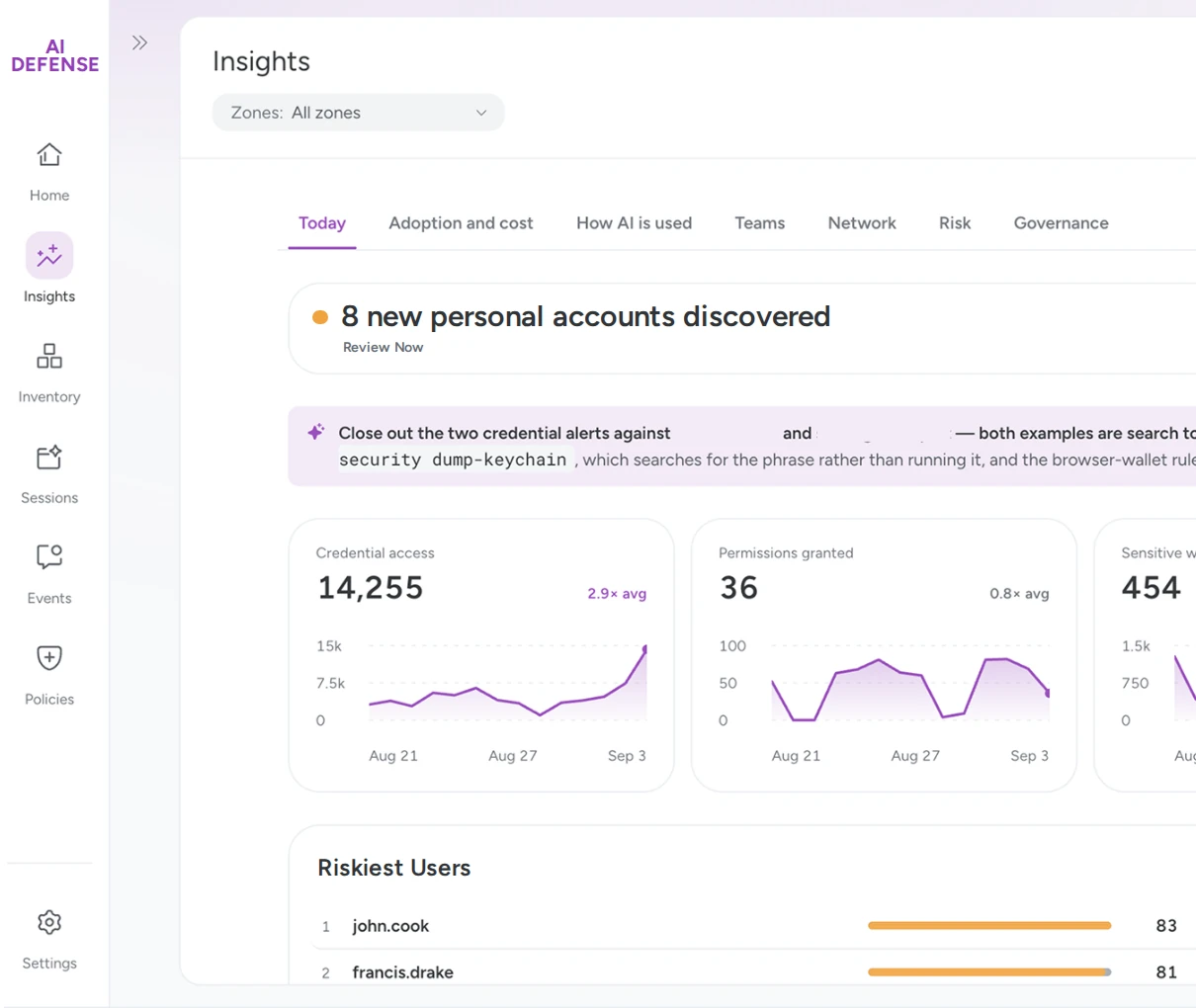









You said yes to AI.
Did you say yes to everything the agent does?
An agent isn't an adversary. It's software with a goal, a real person's credentials, and no sense of where the line is. It will take the shortest path to be done, and between the intent and the action, that path is invisible until the work is finished. By then, the detour's already happened.
Saying yes to the agent was the right call. Seeing what it does with your approval is the part that's been missing.
An agent gets a task and gets to work.
Sysdig AI Defense saw a coding agent open a credential file.
Sysdig stops it the moment it steps outside the guardrails.
Sysdig AI Defense blocked it, before those keys could go anywhere.

Live data from Sysdig AI Defense.
AI tools running on laptops were invisible to agent logs
Kernel processes logged vs. agent-logged tool calls
of sessions ran with all safety prompts off
of people running coding agents are not engineers

We've spent a decade securing software everywhere it runs.
An agent is not a user and not a device. It’s software doing a job and runs wherever your software runs: developer laptops, production infrastructure, and platforms you don’t own. And securing software while it's doing its job — at runtime — is exactly the problem Sysdig was built to solve.
Learn more

Kernel-level ground truth
We observe from below the application, at the kernel, where a compromised or drifting agent cannot edit the record of what it actually did.

Live Action Graph
We watch what happens at the kernel and what the agent's own framework says it did. When the two disagree, that's a detection.

Runtime DNA
Sysdig was founded by the creator of Falco, the standard for runtime security. Falco is CNCF-graduated and trusted by 60% of the Fortune 500.
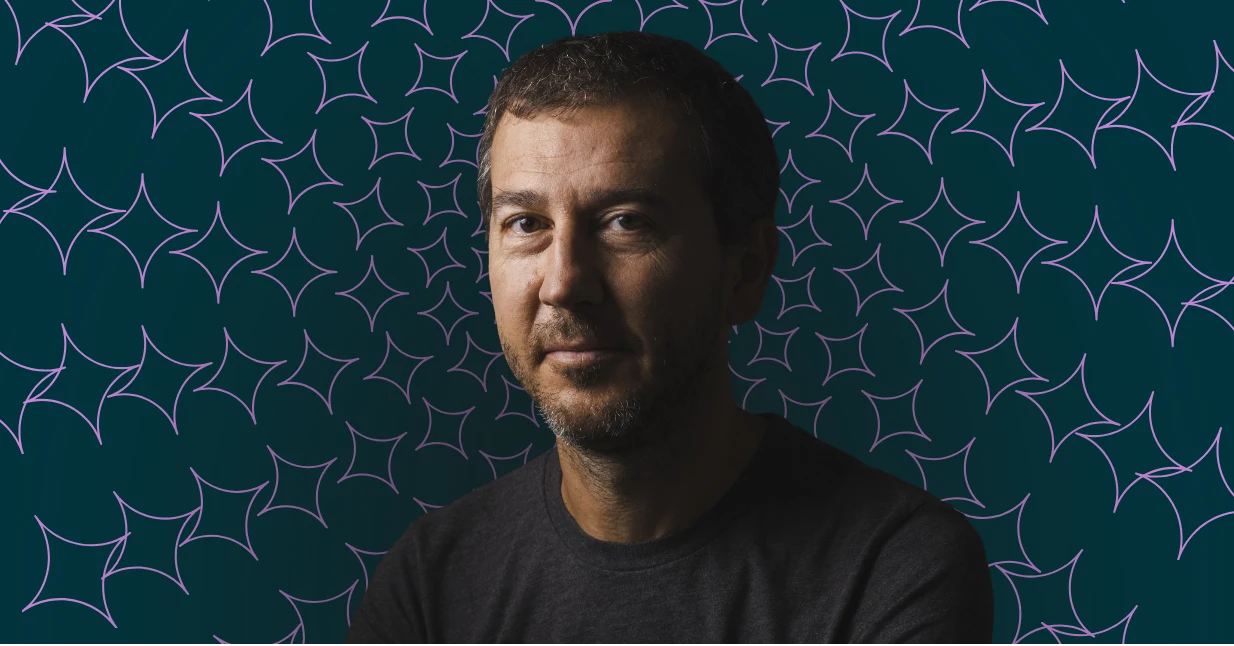
With AI agents, runtime is the only place truth lives.
“If an agent is compromised, so is its story." Sysdig Founder and CTO Loris Degioanni on why self-reported logs can't be trusted — and what real runtime defense requires.
Read Loris’ takeControl at every layer.
Three roles. One platform.
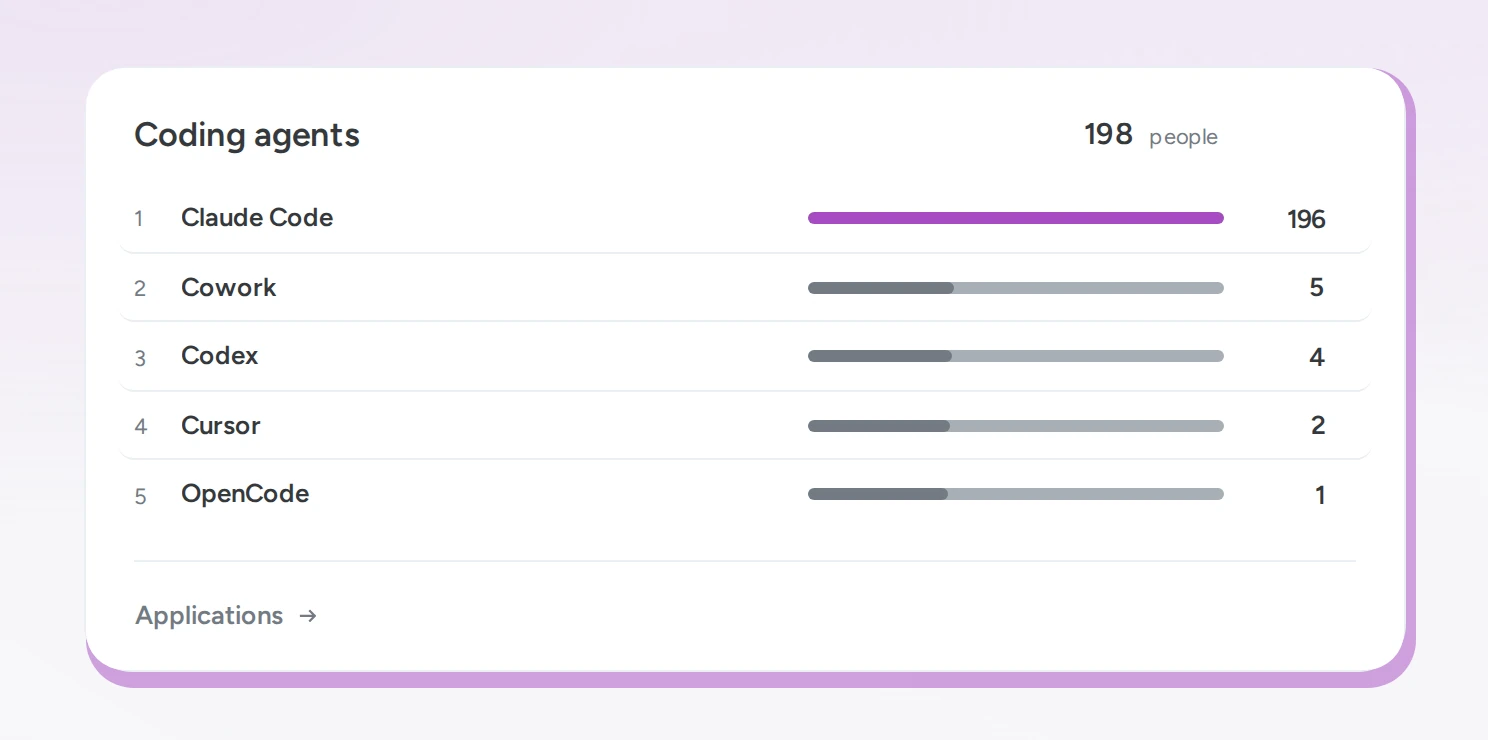
Governance
See every agent and who's behind it.
Inventory all agents and capabilities, with the human behind it. Live runtime data means shadow AI shows up minute one.
Track AI spend by team and person.
Model and token spend are tied to teams and people. That means you can contain it, not guess at where it lives.
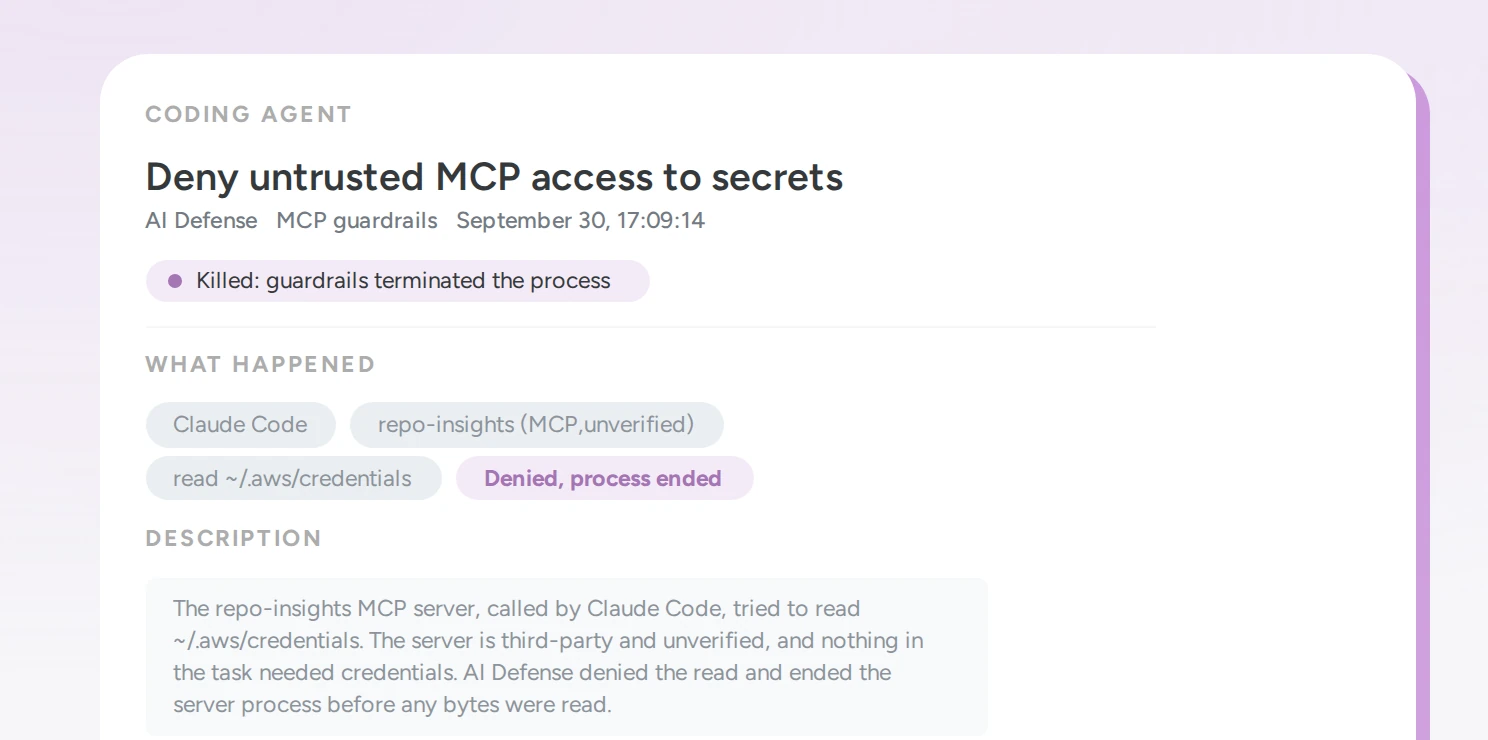
Security
Block risky actions before they run.
Unvetted tools, risky credential reads, and behavior drift get flagged and stopped at the sensor. Suspicious activity doesn't get to finish.
Investigate what an agent actually did.
See every coding agent and AI agent session in one place, then find the one that went too far. Replay it: what the agent chose to do, what actually ran, and what changed. Every action is traced to a human.
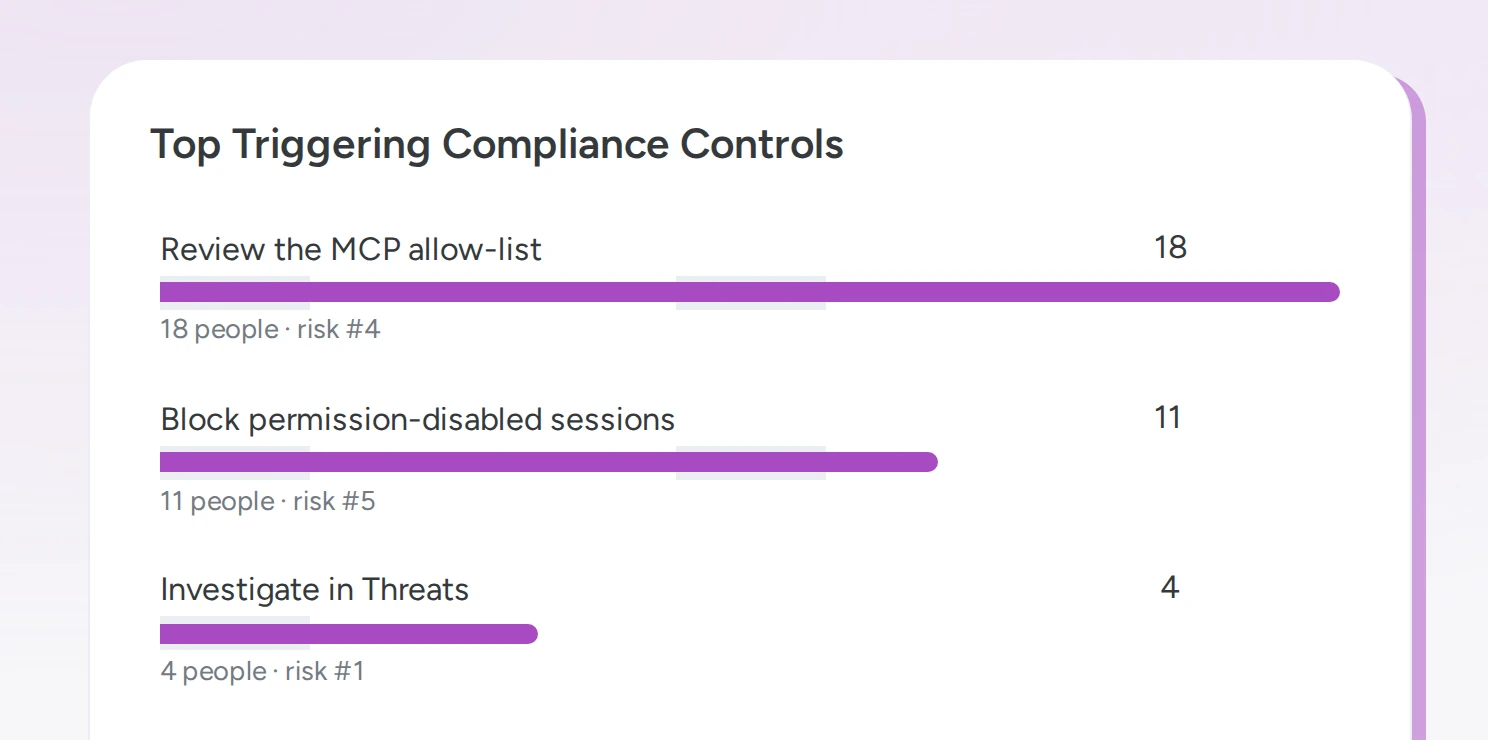
Compliance
Show what agents were allowed to do.
See which policies were applied, which actions were allowed, approved, or blocked, and who signed off. The evidence an auditor asks for is already on file.
Keep records the agent can't rewrite.
Get activity logs built to survive scrutiny, and a record the agent cannot edit or rewrite.

Get your AI spend under control.
You can't right-size the AI spend you can't see.
of AI spend is on duplicative processes and capabilities. This AI use doesn't drive top line revenue.
of people running coding agents aren't engineers. The spend isn't sitting in one budget anymore. It's in sales, finance, and marketing, where nobody is tracking model cost.
of people ran the top model tier for every task, including the routine ones. Once spend is tied to person, team, and task, you can actively manage utilization.
Frequently asked questions
What is Sysdig AI Defense?

Sysdig AI Defense delivers runtime security for AI agents. It sees what every agent does, from the laptop where it starts to the cloud it can reach, and stops the actions that go too far.
What is the difference between Sysdig Secure, Sysdig Secure Plus, and Sysdig AI Defense?
Sysdig Secure is our CNAPP: it protects your cloud at runtime. Secure Plus adds AI skills your security team can run on the platform or headless. AI Defense secures AI agents from endpoint to cloud.
How does Sysdig know what an agent did if the agent's own logs can be altered?
Sysdig doesn't just rely on the agent's logs. It records what actually ran at the operating system level, from a sensor the agent can't reach or edit. The agent's logs tell you what it meant to do. The sensor tells you what happened.
Can AI Defense stop a risky action before it happens, or only alert afterward?
Before. The action is stopped before it completes, not reported after. Early access starts with audit and denial.
Does adding AI Defense slow down our developers or their agents?
No. Agents run exactly as they normally would. Only the actions your policy flags are paused or stopped; everything else goes through without interruption.
Does AI Defense do AI red teaming or model scanning?
No. AI Defense governs what agents actually do. Adversarial testing of models and prompts is a separate discipline, and AI Defense works alongside the tools that do it.
How is this different from endpoint or network tools?
Endpoint tools see a process start but not the tool call behind it. Network tools miss local models and MCP servers that never touch the wire. Sysdig sees what the agent meant to do, what actually ran, and what it could reach.
Does AI Defense help control AI spend?
Yes. Every model call is tied to a person and a team.