Introducing headless cloud security: Run Sysdig inside your AI coding agents




Falco Feeds extends the power of Falco by giving open source-focused companies access to expert-written rules that are continuously updated as new threats are discovered.
For over a decade, Sysdig has built the most comprehensive runtime security data in the industry. Today, we're redefining how security teams consume it. Security is moving to the AI coding agent, and we're leading that shift. With headless cloud security, Sysdig becomes the security expert embedded inside your AI environment.
This is not a new or different dashboard you log into. This is not an incremental improvement to cloud security. It is a new operating model for it. Headless cloud security delivers an intelligence layer that operates inside the tools where your team already works: AI coding agents like Claude Code.
What headless actually means
Headless systems decouple the backend from the frontend. The data, logic, and intelligence remain, but are consumed through APIs instead of a vendor-defined UI. What changes is who, or what, consumes them. The assumption is that consumers will build their own interface or use no interface at all.
Applied to cloud security, headless means you have everything you need to operate the Sysdig cloud-native application protection platform (CNAPP) without using the out-of-the-box UI:
- Security can be controlled and customized through AI coding agents like Claude Code, Codex, and Cursor.
- APIs are packaged as MCP servers, enabling AI agents to invoke them directly with intent rather than raw calls.
- Agent skills implement the core cloud security workflows grounded in Sysdig’s expertise, so the agent is not simply executing commands but operating with a decade of accumulated security knowledge behind every action.
The result is a cloud security platform that is natively integrated with tools you already use to manage security for your business.
What disappears is the vendor-prescribed interface. What stays is everything that matters: runtime-grounded signals, detection logic, and context that tells you not just what is wrong but why it matters and what to do about it.
Because security now runs inside the coding agent, what becomes possible is something UI-first platforms cannot deliver: native integration with the tools where fixes actually happen, like Git, Jira, and CI/CD pipelines. This means you get true end-to-end remediation, from detection to pull request, without leaving your environment.
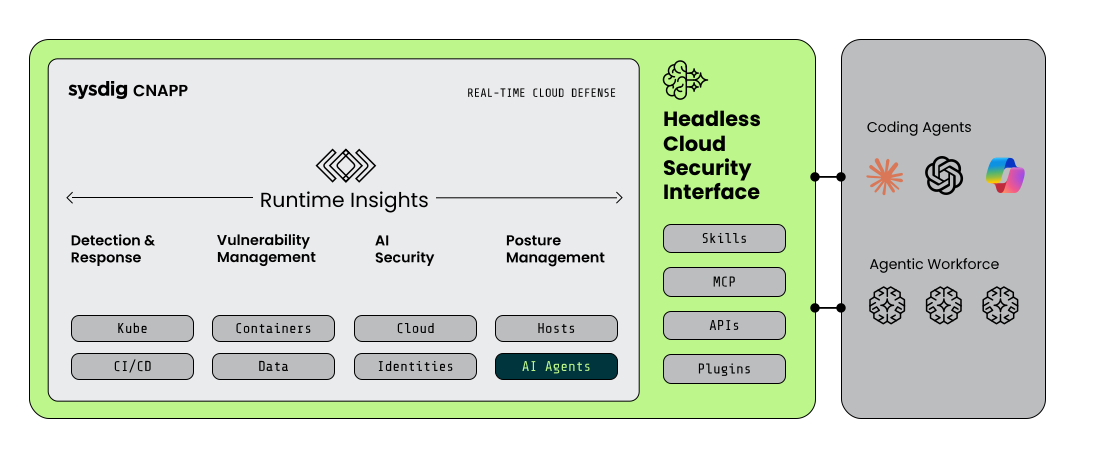
Headless cloud security is not simply an alternative way to consume the Sysdig platform. It expands what the platform can do. Integrations that were previously custom work become native, programmability unlocks workflows that no UI can support, and context from the customer's own environment continuously enriches how security operates.
The Sysdig UI remains the right interface for teams who prefer it. Headless cloud security is for teams who have already moved beyond the UI as their primary control surface — and for those who will.
The shift to headless is already happening
Customers further along in their AI journey are already moving in this direction. They want coding agents that triage alerts, generate Jira tickets, and open pull requests with proposed fixes. They want to route critical events to the people who need to act on them, without switching tools. They've started pulling Sysdig data via API and feeding it into their own orchestration layers.
Headless cloud security is what makes the full workflow possible: not just the data access, but the expertise, the guardrails, and the end-to-end integration that turns signals into action.
The same headless shift is happening across enterprise software broadly. The interface is being separated from the platform, and AI agents are becoming the primary operators of complex systems. Security is not exempt from this shift. If anything, security is where it is most urgent, because attackers are already operating at machine speed, and human-driven workflows cannot keep pace.
AI is only as good as the data behind it
Data access is only part of the picture. You also need an intelligence layer: the security insights, the prioritization logic, the workflow expertise, and the context that turns a signal into an action.
This is the Sysdig advantage.
Our platform delivers the highest-fidelity deterministic data in the industry. In a headless model, deep, real-time, contextual insights into workloads, containers, and cloud services enable AI agents to understand a customer environment, analyze risk, and take steps to reduce it.
We have been building our security intelligence layer for over a decade. Our detections, controls, and response workflows, built on top of Falco runtime signals, represent accumulated security knowledge that no API wrapper can replicate. That means your agents are operating with context, prioritizing what matters, and taking action based on real runtime behavior.
Putting it all together, here’s what makes headless cloud security drive better outcomes in practice.
It starts with runtime context
Sysdig signals are rooted in actual runtime behavior, not static analysis. When a coding agent queries Sysdig for vulnerability prioritization, it gets signals grounded in real execution context: what is actually running, what has network exposure, and what is exploitable in your specific environment. That deterministic foundation is what makes agent-driven security trustworthy rather than speculative.
It has built-in governance
Every action taken using a CNAPP skill is logged and auditable. Human approval gates are supported throughout. The agent proposes and the human decides. This is not a feature; it is a core architectural principle. Enterprise security teams cannot adopt autonomous workflows without full transparency into what is happening and why.
The expertise is included
Agent skills combine data, workflow logic, and domain expertise into reusable units your AI environment can consume directly. You don’t have to build the intelligence layer yourself. It comes with Sysdig.
It works across the tools you already use
Agents connect systems like Slack, Jira, and GitHub, so investigation and response happen inside your existing workflows, not across disconnected tools. Correlation of signals from across your security stack delivers deeper insights and drives better decisions.
And it gets better over time
From the first interaction, agents build a contextual understanding of your environment: what’s critical, what’s normal, and what matters most. Each action improves the next, sharpening prioritization and response.
Four cloud security flows, available now
We’re starting with four workflows designed around specific operational problems security teams deal with every day.
Vulnerability management with remediation
Instead of manually triaging CVEs and coordinating fixes across teams, the agent identifies the highest-risk vulnerabilities, determines ownership, opens a Jira ticket, and generates a pull request with the fix.
What you get back: the hours spent chasing remediation across disconnected tools.
Posture management, tailored to your environment
Most tools assume a generic environment. Yours isn’t. Your architecture, your risk tolerance, and your compliance requirements are specific to you. The agent lets you define policies in natural language and translates them into enforceable controls.
What you get back: the overhead of writing and maintaining custom policies.
Runtime threat investigation
Investigations today require stitching together signals across tools and building a mental model of what happened. The agent correlates runtime events, vulnerability data, and threat intelligence, then maps attack paths and generates a structured report.
What you get back: hours of manual correlation and reliance on your most experienced analysts.
Onboarding, without the overhead
Getting started shouldn’t be a project. The agent generates a configuration, validates prerequisites, and deploys coverage with full transparency and approval at every step.
What you get back: the time spent getting to “day one” before you can actually operate.
Two sides of the coin:
AI for security and security for AI
While we enable the new operating model driven by AI coding agents, securing those agents is also a critical practice. Sysdig has you covered here as well. Our platform enables you to protect AI workloads, agents, and the data behind them.
Runtime security for AI coding agents monitors agent activity to identify suspicious behavior and help you prioritize risk. This starts with automatic discovery of agent installation and AI use in your environment, helping you know when and where sanctioned AI — or unsanctioned AI (aka shadow AI) — is being used. Like any workload across your estate, our goal is to help you move fast while staying on top of risk.
Enable AI adoption with confidence
The goal is to support teams in moving faster with AI, all while maintaining the visibility and control needed to operate securely.
Know where and how AI is being used
Gaining insight into both sanctioned and emerging AI usage ensures teams stay aligned with internal policies without slowing innovation.
Align security with AI-driven development
As teams integrate coding agents and copilots into daily operations, security needs to evolve alongside them to support this new way of working.
Where we’re taking headless cloud security
The cloud security market has spent years competing on dashboards — better visualizations, richer context, and smoother navigation. Those still matter for teams operating through a UI, but they’re no longer the defining advantage. The shift underway is toward AI-driven workflows, where security is executed through agents, not dashboards. In this model, differentiation comes from how deeply a vendor’s data, expertise, and workflows are embedded into your AI environment, not how polished the interface looks.
Headless cloud security is how Sysdig delivers on that shift. By packaging security knowledge, context, and runtime intelligence into agent-native skills, Sysdig becomes part of how work actually gets done — integrated into your tools, automation, and AI stack. Over time, this creates a durable advantage, as the solution that’s embedded in the workflow becomes foundational to it. That’s the position Sysdig is building toward: becoming the infrastructure layer for cloud security in an AI-driven world.
Get started
Headless cloud security skills are available today for existing Sysdig customers. If you are a security or platform engineer who has already adopted coding agents as part of your toolchain, this is built for you.
If you are a security leader whose engineers have started building around your security stack with AI, this is worth a conversation.
Learn more about headless cloud security here.
End-to-End Cloud Security
Learn more about Sysdig's unified platform, protecting cloud, containers, and workloads.
Sysdig Headless Cloud Security
AI-driven attacks unfold in minutes — humans can't keep up. See how Sysdig exposes CNAPP capabilities as programmable APIs and MCP services so AI agents can detect, investigate, and respond directly inside your workflows.
Attackers Move at Machine Speed. Do You?
The new data is in. Explore how leading teams are shifting from manual effort to machine-speed defense — covering the limits of vulnerability management, the rise of runtime detection, AI/ML in production, and the future of automated identity enforcement.

Your Blueprint to Agentic Cloud Security
A practical guide to doing agentic security the right way. See how Sysdig Sage™ uses contextual, autonomous AI to cut alert noise, prioritize what actually matters, and accelerate response at the speed of modern cloud threats.