



Falco Feeds extends the power of Falco by giving open source-focused companies access to expert-written rules that are continuously updated as new threats are discovered.
Our 2026 Cloud-Native Security and Usage Report confirms that security teams are taking vulnerabilities seriously, with a 75% YoY reduction in exploitable in-use vulnerabilities. However, it also revealed a concerning trend: Vulnerabilities are growing, and teams are struggle to keep up.
Are we reaching the limit of human scale? And, if so, what can security teams do to catch up?
An exponential growth in vulnerabilities
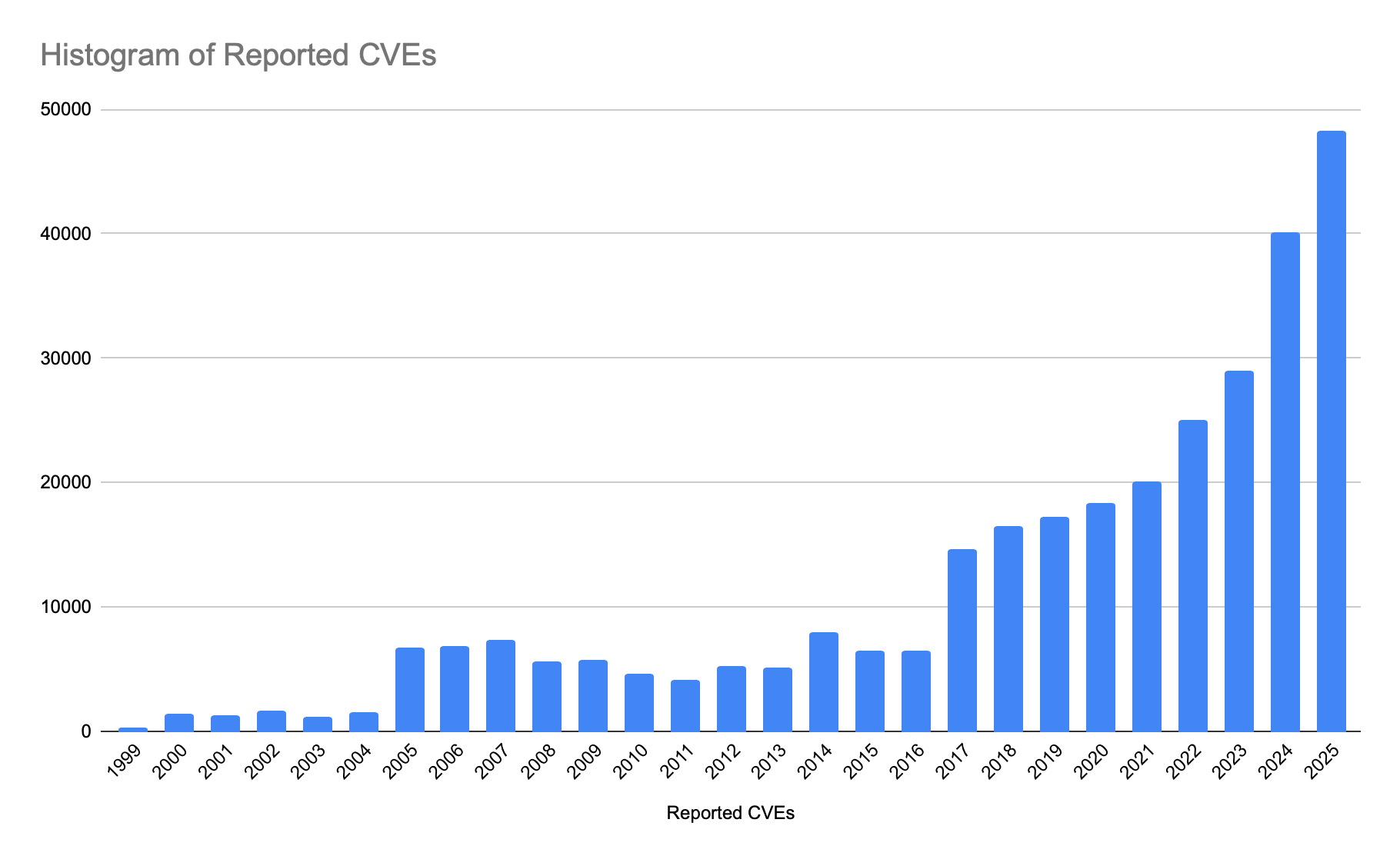
The MITRE Corporation tracks reported vulnerabilities on cve.org. The trend is scary, showing an exponential growth in recent years:
To help our users navigate this issue, we introduced Risk Spotlight in 2022. This tool assists Sysdig users in identifying vulnerabilities that are in use, have an existing exploit, and have a fix available. A 75% reduction in this kind of vulnerability year-over-year among our users demonstrates how effective Risk Spotlight is.
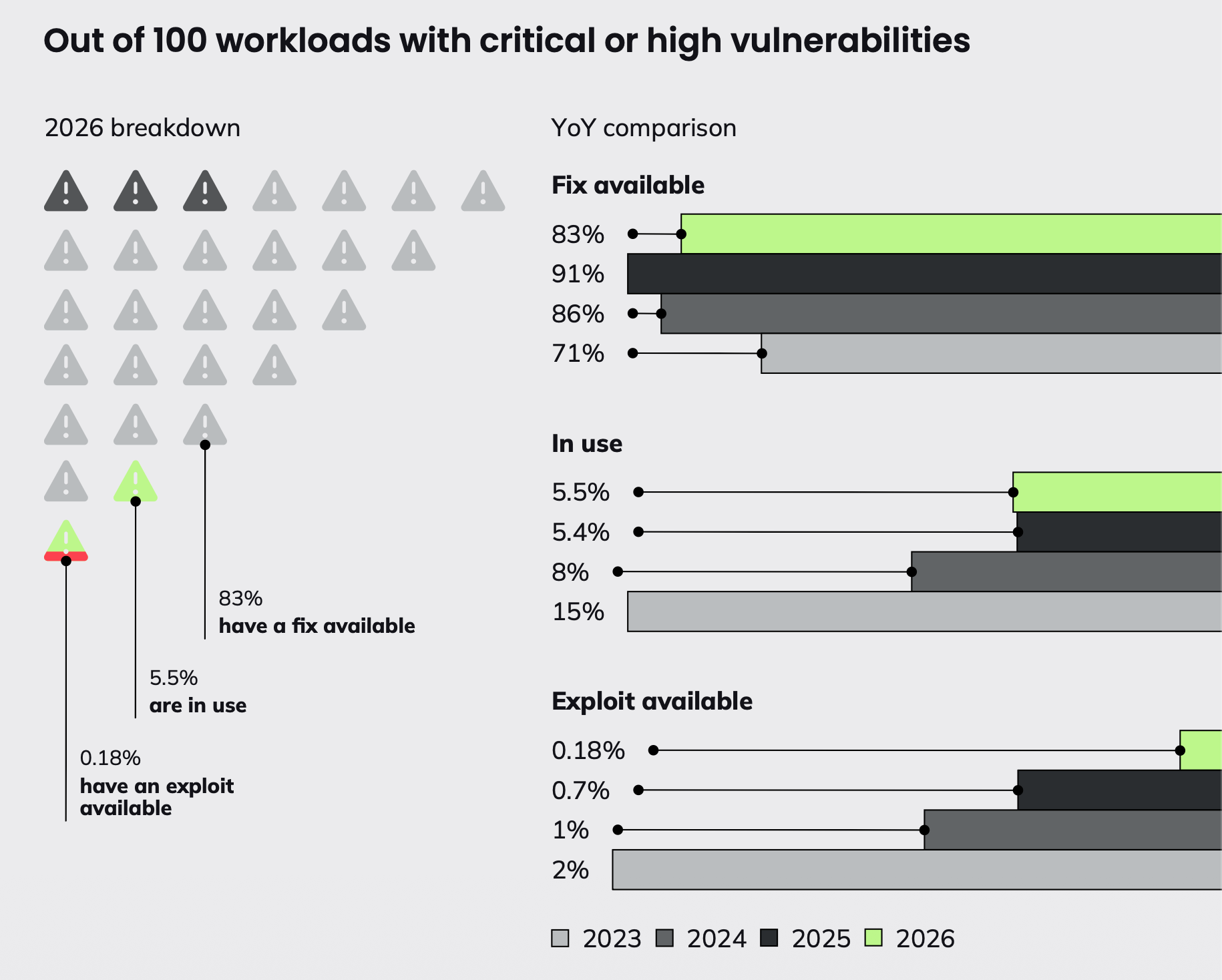
This metric also highlights the impact that security tools have when they align with the user’s needs.
However, in-use vulnerabilities, including those without a known exploit, have plateaued at 5% since last year.
This shows that while teams are doing great work prioritizing, they struggle to address the overall exponential increase in vulnerabilities. As a result, there is a huge gap with the in-use vulnerabilities without known exploits.
What is new this year is that the absence of a known exploit no longer guarantees security. An exploit can be crafted and weaponized within a few hours with the use of AI, as the Sysdig Threat Research Team (TRT) and Project Glasswing are proving over the last few weeks.
AI is changing how we think of vulnerabilities
Dealing with vulnerabilities running in production is becoming increasingly important as the window between vulnerability disclosure and exploit weaponization collapses. According to VulnCheck:
- In 2018, attackers took nearly a year to weaponize vulnerabilities.
- By 2023, it was only eight days.
- At the end of 2025, React2Shell was being actively exploited just hours after its disclosure.
- And earlier in 2026, it took less than 10 hours for CVE-2026-39987 with no proof of concept to use as reference.
And now, we’ve seen how AI is expanding to cybersecurity. On the one hand, Anthropic’s Project Glasswing is an AI capable of detecting software vulnerabilities, deemed too risky for the general public. On the other hand, we’ve recently seen how an AI-assisted cloud intrusion achieves admin access in 8 minutes.
We expect that, as attackers continue to use AI in their operations, vulnerability weaponization will approach near‑real time. With this scenario in mind, focusing solely on vulnerabilities being actively exploited is no longer enough, and runtime security takes on greater importance as a last line of defense.
The next step in automation
Slowly, but steadily, organizations have realized the value in stateful detections and also shifted to automated response actions for modern threats. According to our 2026 Cloud-Native Security and Usage Report, the adoption of automated response is surging:
- More than 70% of organizations use behavior‑based detections across 91% of environments to improve signal quality.
- 140% more organizations auto-kill processes when detection is triggered.
However, to cope with the exponential growth of vulnerabilities and break through the 5% ceiling, organizations need a paradigm shift in their tools. More and more, AI is becoming not only the natural next step in automation, but economically and operationally justified.
We believe that autonomous remediation, driven by agentic AI and executed within human‑driven guardrails, is how organizations will keep pace with shrinking exploit timelines.
The importance of AI guardrails
You may shiver at the thought of granting power over your infrastructure to an AI; it’s understandable. However, the key to success is in the details.
We’ve been here before. A few years ago, automating tasks in critical areas was also a controversial topic. What has changed since then to explain the widespread adoption of automated responses we detected in our report?
A silent transformation in the industry has taken place over the last few years. Engineering has adapted to put automation first. Practices that sounded peregrine, like CI/CD, Infrastructure as code, and DevOps, are now the norm. At the same time, tools, policies, and processes have matured to keep automations within safe margins.
As a result, suspicious processes are now killed automatically, which was something unthinkable years ago.
Organizations adopting agentic AI must undergo a similar transformation to succeed. Agents are a lot like kids; in the absence of guardrails, they will introduce operational risk at some point. These guardrails become the new focus of humans in the agentic era, in particular:
- Write policies to define change limits.
- Scope permissions and privileges.
- Deterministic rollbacks.
- Audit logs, output, and explainability of agents.
- Risk thresholds with environmental context.
Only when humans govern and define these guardrails can they advance with machine‑speed security.
Agentic AI is the next step
This is the problem Sysdig Sage™ is built for. As an AI cloud security analyst integrated into the Sysdig platform, it applies multi-step reasoning to live runtime intelligence — identifying which vulnerabilities are active, exploitable, and worth acting on, and cutting vulnerability noise by 95% in the process. It doesn't replace human judgment; it operates within the guardrails your team defines, so action stays scoped, auditable, and reversible. When exploit timelines collapse from days to hours, the teams that keep pace are the ones whose AI works from what's actually running — not static scans.
Conclusion
The cybersecurity ecosystem is moving faster than human speed. In the cat-and-mouse game that cybersecurity is, it's no longer enough to focus on some vulnerabilities, as automating runtime response with agentic AI is becoming a requirement.
If organizations want to succeed in this change of paradigm, they must go through a transformation to ensure they are in control of their agent’s guardrails.
Get more insights on our 2026 Cloud-Native Security and Usage Report.