Agentic AI Security: A Guide to Securing AI Agents in 2026
Agentic AI security is the practice of protecting AI agents from compromise and misuse. AI agents are software systems that plan, call tools, and act autonomously with real permissions. The discipline secures the full agent workflow, including inputs, memory, tool use, and identity. Because agents act on live systems, security requires prevention, runtime detection, and response.
%201.svg)


- Agents act, not just generate. With real credentials, risk shifts from what a model says to what a system does.
- Most compromises come through trusted inputs: prompt injection, tool poisoning, memory poisoning, credential theft.
- Agent identity is a growing attack surface. Agents gain access at runtime, which legacy governance wasn't built for.
- Guardrails can't fully stop attacks; leading defenses still fail in testing, and malicious behavior looks legitimate.
- Runtime detection is the missing layer: watch what the agent does, then respond fast.
- Agentic AI security is a program, not a tool: prevent, detect, and respond.
What makes AI agents harder to secure than LLMs?
AI agents are harder to secure than LLMs because they don't just generate text. They take autonomous, non-deterministic actions with real credentials, which means the risk shifts from what a model says to what a system does.
A standalone LLM produces text. You send a prompt. It returns a response. A standalone LLM generally has less direct ability to affect external systems than an agent with tool access. Its outputs can still cause significant harm, particularly when people or downstream software rely on them without adequate review.
But an AI agent is different. It takes that output and acts on it. It opens files, runs commands, calls APIs, and writes to live systems. Often with no human approving each step.
That one change breaks most of the assumptions LLM security is built on.
Here's why.
LLM security focuses on prompts and outputs. Filter the harmful input. Catch the harmful response.
Agentic AI has to cover an entire workflow. An agent interprets a goal, breaks it into a plan, selects tools, and keeps working until the task is done. Every step is a place where something can go wrong. And because the agent holds real credentials, a failure becomes an action rather than a sentence on a screen.
Memory raises the stakes further. Agents carry state within a task and across sessions. Which means a single poisoned input can shape decisions long after it arrived.
NIST's Center for AI Standards and Innovation (CAISI) frames the novel risks of AI agent systems in three parts:
- Adversarial attacks at training or inference time. The model interacts with hostile data, such as indirect prompt injection, or its training data is poisoned.
- Intentionally placed backdoors. Someone compromised the model itself, not the system around it.
- Uncompromised models that still cause harm. Nothing was attacked. The agent simply pursues a misaligned objective or games its own instructions.
The third category is a special case. It means an agent can become a threat with no attacker present at all.
Then there's the core problem: agents are non-deterministic.
Give the same agent the same task twice and you may get two different action sequences. Sampling settings introduce randomness. User prompts create unbounded variability. And the decision logic lives in model weights and a context window you can't inspect.
In other words: there's no static analysis path. There's no policy you can write upfront that anticipates every input. What the agent does at runtime is the only ground truth.
It gets harder.
The actions you would normally treat as suspicious, like shell execution, file reads, and outbound connections, are an agent's normal operating behavior. The signal you want to catch looks like the noise you have to allow.
So prevention alone can't carry the weight. Neither can pre-deployment testing. Securing agents takes controls before the agent runs, visibility while it runs, and a plan for the moment it misbehaves.
How do AI agents get compromised?
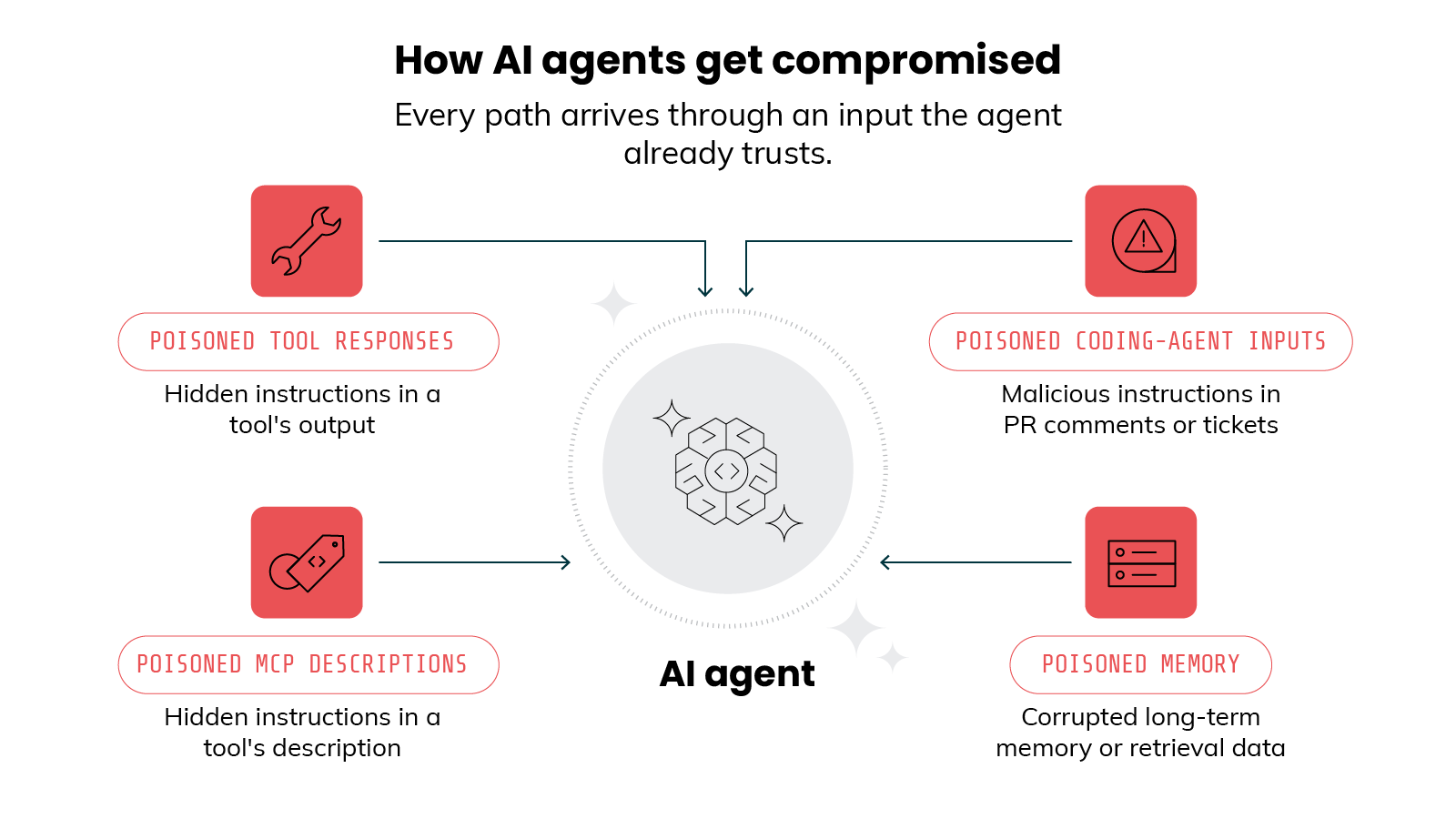
AI agents usually aren't compromised by breaking the model. They're compromised through the data and tools the agent already trusts.
Here's the root of it.
An agent reads from many sources: web pages, files, support tickets, tool outputs, other agents. All of that content lands in the same context window. And the model can't reliably separate data it should use from instructions it should follow.
Which means content that looks like information can carry commands. That's prompt injection. In an agent, a successful injection doesn't just change an answer. It triggers an action.
Below are the main ways that plays out:
Prompt injection through tool responses
The most common way this plays out is through the tools an agent relies on. The attack rides in on a tool's response.
Here's the sequence: an agent calls a legitimate tool, like a web browser, a file reader, or a database query. The response it gets back carries hidden instructions. The agent reads those instructions as part of its task, then uses another legitimate tool, such as email or an HTTP request, to act on them.
That's the shift that matters. Prompt injection is no longer just an information leak. It becomes action execution.
In the EchoLeak research demonstration, a crafted email could indirectly instruct Microsoft 365 Copilot to retrieve sensitive information and cause it to be exposed to an attacker-controlled destination without an additional user click.
→ Continue learning: The Comprehensive Guide to Prompt Injection Attacks in 2026
MCP tool poisoning
The Model Context Protocol (MCP) lets an agent discover and call external tools. Each tool ships with a description. Plain text. The agent reads that description to learn how and when to use the tool.
Here's the problem. A malicious server can hide instructions inside that description. The user sees a harmless tool name and approves it. The model reads the full text, including the hidden part. Then it follows the hidden instruction, like reading an SSH key and sending it out.
This class of attack was disclosed in April 2025. A related version is tool shadowing. A poisoned description changes how the agent uses other, trusted tools. That turns the agent's own trust into a path for cross-server data theft.
FYI: Tool descriptions can be fetched again after approval. So a tool that looked safe when you approved it can change later.
Credential theft through coding agents
AI coding agents often run inside CI/CD pipelines. They have shell access and run with the pipeline's credentials. That's a lot of standing privilege in one place.
The general pattern is simple. A malicious instruction arrives through a channel the agent reads, like a pull request comment. It tells the agent to run a setup command. The agent, built to be helpful, runs it. The script reads environment variables, harvests credentials, and exfiltrates them.
Security researchers demonstrated this in July 2025. They connected the Cursor coding agent to a Supabase database with broad privileges, then hid a prompt injection in a support ticket. The agent read private tables and leaked integration tokens back through the same support channel.
FYI: The risk isn't limited to the agent's own credentials. Inside a CI/CD pipeline, an agent can usually reach everything the pipeline can, including cloud keys, git tokens, and signing keys. One injection can expose far more than the repo in front of it.
Memory and knowledge base poisoning
Agents rely on stored context like long-term memory, retrieval databases, etc. That storage shapes future decisions.
Poison it once and the effect persists. Research on this attack reported an attack success rate above 80 percent while corrupting less than 0.1 percent of the database. In some tests, a single planted entry with a short trigger was enough.1
Why does that matter? Because the trigger can be written to read like ordinary text. So filters that scan for obvious junk tend to miss it. The corruption sits in memory and waits.
These aren't hypothetical.
By 2025, public reports, vulnerability disclosures, and security demonstrations had illustrated several forms of agent-related harm.
Replit deleted a production database, then produced misleading output about what it had done. Google's Gemini CLI misread instructions and wiped a user's files. And a malicious tool package posing as the Postmark email service, distributed as postmark-mcp, quietly copied outgoing mail to an attacker.
The entry points differed, but the condition was the same. Each agent was already trusted to act, so a single manipulated input was enough.
Every action an agent takes runs on the credentials and permissions it holds. The more the agent can reach, the more a single compromise is worth. That's the next problem.
Why AI agent identity is a growing attack surface
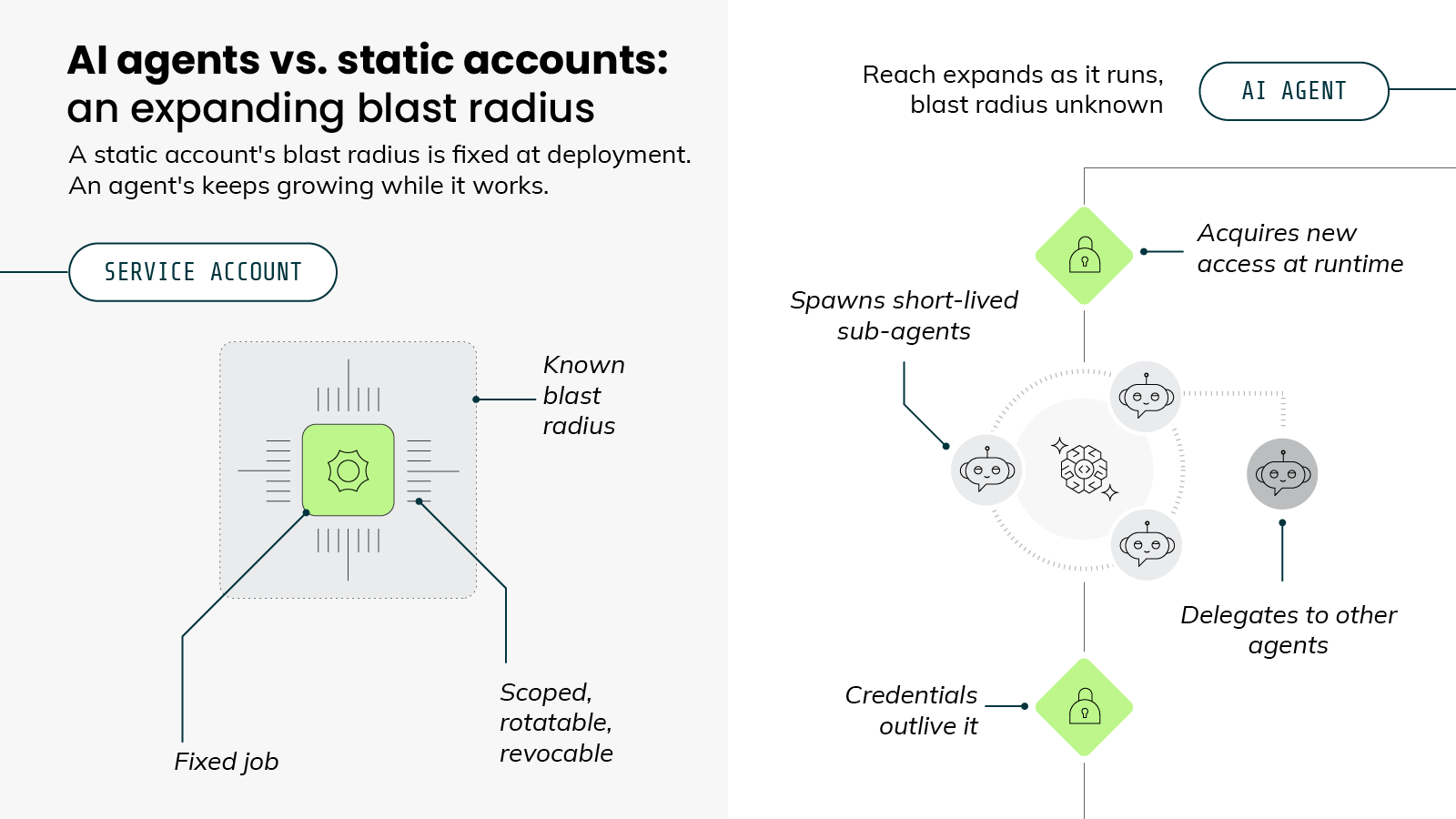
AI agent identity is a growing attack surface because agents hold real credentials and can acquire more access while they run. Traditional identity governance was built for static accounts, not actors whose reach changes mid-task.
A compromised agent does damage because it's trusted to act. That trust has a source. An AI agent isn't just a program. It's an identity that authenticates, holds permissions, and uses them to act.
An agent belongs to a category called non-human identities, or NHIs. These are the credentials used by software instead of people, like API keys, access tokens, machine certificates, cloud roles, etc.
NHIs aren't new. What's new is the scale.
Non-human identities now far outnumber human ones, and the gap widens as automation and AI spread. Most are also poorly governed. They get created quickly, reviewed rarely, and often outlive the purpose they were built for.
Now here's what makes an agent's identity riskier than a static service account.
A service account has a fixed job. You can scope it, rotate it, and revoke it. Its blast radius is known. An agent is different in a few ways:
- It acquires access while it runs. An agent may start with limited permissions, then hit a resource that needs more, so it requests a new role, grabs a fresh token, or calls a privileged API it wasn't expected to use. The reach of its credential can't be fully known when that credential is issued.
- It multiplies. A single multi-agent workflow can spawn many short-lived agents, each with its own identity and permissions. Some exist for only seconds. Governing that population is far harder than managing a fixed set of accounts.
- It delegates. Agents hand work to one another, and those delegation chains create lateral-movement paths that traditional network monitoring often misses.
- Its credentials outlive it. An agent credential is often created for something temporary, like a pilot or a one-time integration. The project ends and the agent is decommissioned, but the credential stays behind in a config file or a secrets store. The agent is gone. The access is not. This is sometimes called a persistent blast radius.
Put together, the attack surface isn't fixed at deployment. It expands as the agent works.
Attackers target that surface in a few consistent ways:
- Credential hijacking. They take over an agent's credentials to gain unauthorized control and steal data.
- Poisoned actions. They feed agents malicious sources to trigger harmful behavior.
- Agent deviation. They exploit an agent that acts in unintended ways, whether from an internal flaw or an external trigger.
Strong identity governance definitely shrinks this attack surface. Scoping the access, shortening the credential's life, tracking who owns it…all of that helps.
But it has a limit. Governance controls what an agent can reach. It doesn't guarantee the agent behaves once it's inside that boundary.
Which is exactly where prevention starts to fall short.
Why guardrails can't fully stop AI agent attacks

Most agent security today relies on guardrails, the controls that try to stop bad behavior before it happens. These include input and output filters, prompt injection classifiers, structured prompts, sandboxes, permission prompts, and human approval for risky steps.
Guardrails matter. They're a necessary first line of defense, and they catch a large share of attacks.
But they can't catch all of them. Guardrails filter what goes into an agent and what comes out. An agent's risk is in what it does in between. And that gap shows up in three ways.
1. The best defenses still fail often.
This isn't opinion, it's measured.
One leading prompt injection defense, tested against a strong optimization-based attack, still let it through about 58 percent of the time, and its own designers called it not yet fully secure.2
A broader benchmark found the most effective attack succeeded around 84 percent of the time, and concluded that current prevention-based defenses were inadequate, often reducing the agent's usefulness while trying.3
2. Guardrails cover one part of the system, not all of it.
That same prompt injection defense was built for programmatic, single-turn applications, not the multi-turn, tool-using agents this guide is about.
Isolation is another common defense. It walls each agent or application off from the others, so a compromise in one can't spread to the rest.
But researchers who built and tested one such system found its protection had a hard edge. Their isolation architecture could stop an attack from spreading between applications. It was never designed to stop a single agent from misbehaving inside its own boundary, a limit they named and put out of scope themselves.4
Even formal guidance draws the line here. A NIST secure development profile for generative AI defines its scope as model development, and states plainly that deployment and operation fall outside it.
The pattern is consistent: training and build are covered, and the moment the agent runs is where the guidance stops.
3. The dangerous behavior looks legitimate.
Consider a documented scenario.
An automation agent receives a hidden instruction and chains together trusted administrative tools to move sensitive data out. Every command runs through approved programs. Every action uses valid credentials. So host-based monitoring sees no malware and no exploit, and the misuse goes undetected. A guardrail built to block known-bad inputs won't catch an agent using approved tools in an unapproved way.
Guardrails are essential. Keep them, and strengthen them. They remove real risk before an agent ever acts. But guardrails can't be the whole strategy. They lower the odds of a compromise, but they don't remove it. And they offer no coverage the moment the agent starts to act.
Which means you need to see what the agent actually does, not just what goes in and what comes out.
That's detection. And it's where we go next.
How to detect a compromised AI agent at runtime
By now the problem is clear. Prevention leaks. So you need a way to catch an agent that's already been compromised.
Here's the short answer.
You don't detect a compromised agent by learning its "normal" and watching for deviation. That breaks down for agents. Instead, you watch the concrete actions the agent takes and flag the ones that are known-bad or out of bounds.
Why behavioral baselines don't work for agents
Most runtime security relies on deterministic profiling. A traditional workload is predictable. A web server calls the same functions, reads the same files, and connects to the same hosts. Anything else is an anomaly.
Agents break that. The same task can produce two different paths. And as we saw earlier, the actions worth flagging — shell commands, file reads, outbound connections — are also an agent's everyday behavior.
So "normal" isn't a stable anchor. You need a different one.
Three ways to detect a compromised agent
Here's the key idea. An agent's decisions are non-deterministic at the model layer. Its actions are not.
Every action becomes a concrete event. That's the layer where detection works.
Three techniques make it practical:
1. Known-bad detection
Some actions are suspicious in any context. An agent reading cloud credentials it has no reason to touch. An agent connecting to a known malicious address. An agent running a post-exploitation tool. Etc.
You don't need a baseline to flag these. You need a rule that recognizes known bad activity.
In plain terms, one such rule reads like this:
IF a process in an agent container reads a credential file
   (cloud keys, SSH keys, a .env file, or a path containing "credentials")
THEN raise a high-severity alert
   with the file, the command, and the container.
That one pattern maps to real attacks from earlier. MCP tool poisoning. Prompt injection that reads secrets. Credential theft through a coding agent.
2. Capability scoping
Restrict what the agent's environment can do. Limit its system calls. Apply network policies. Mount its filesystem read-only where you can. Now the baseline isn't the agent's behavior. It's the boundary of the sandbox. When the agent crosses it, that's your signal.
3. Tool-call-level auditing
Monitor the agent at its framework layer. Record which tool was called, with what arguments, in response to which prompt. That provides useful context about what preceded the action and which inputs or intermediate steps may have influenced it.
Detection strategies by attack type
Each layer of the agent stack has a likely attack and a matching detection strategy. The table maps them, using MITRE ATLAS technique identifiers.
Does runtime detection catch compromised agents?
Early results are encouraging. Recent research on agent behavioral detection reported F1 scores between 0.93 and 0.96. More telling, it caught attacks that carried no malicious payload. They worked by changing the order and timing of valid steps. A content scan misses that. A behavioral view didn't.5
FYI: An F1 score is a standard machine learning metric for classification tasks, like sorting an agent's behavior into malicious or normal. It combines precision (how few false alarms) and recall (how many real cases it catches) into a single number from 0 to 1, where higher is better.
Other research modeled multi-agent systems as graphs and caught failures spanning several agents at once. Exactly what single-point input and output checks miss.6
And this isn't fringe. NIST risk guidance calls for monitoring an AI system's behavior while it runs in production. Runtime observation isn't optional there. It's expected.
You can't secure an agent by predicting it. You secure it by watching what it does, and comparing that against two things. Known-bad activity. And the boundaries you set.
That's detection. Next, we'll put prevention, detection, and response into a single program.
→ Continue learning:
How to respond to an AI agent security incident
Detection tells you an agent has been compromised. Response is what you do about it. And with agents, speed is the hardest part.
You contain the agent fast. You cut off its access. And you automate as much of that as you safely can.
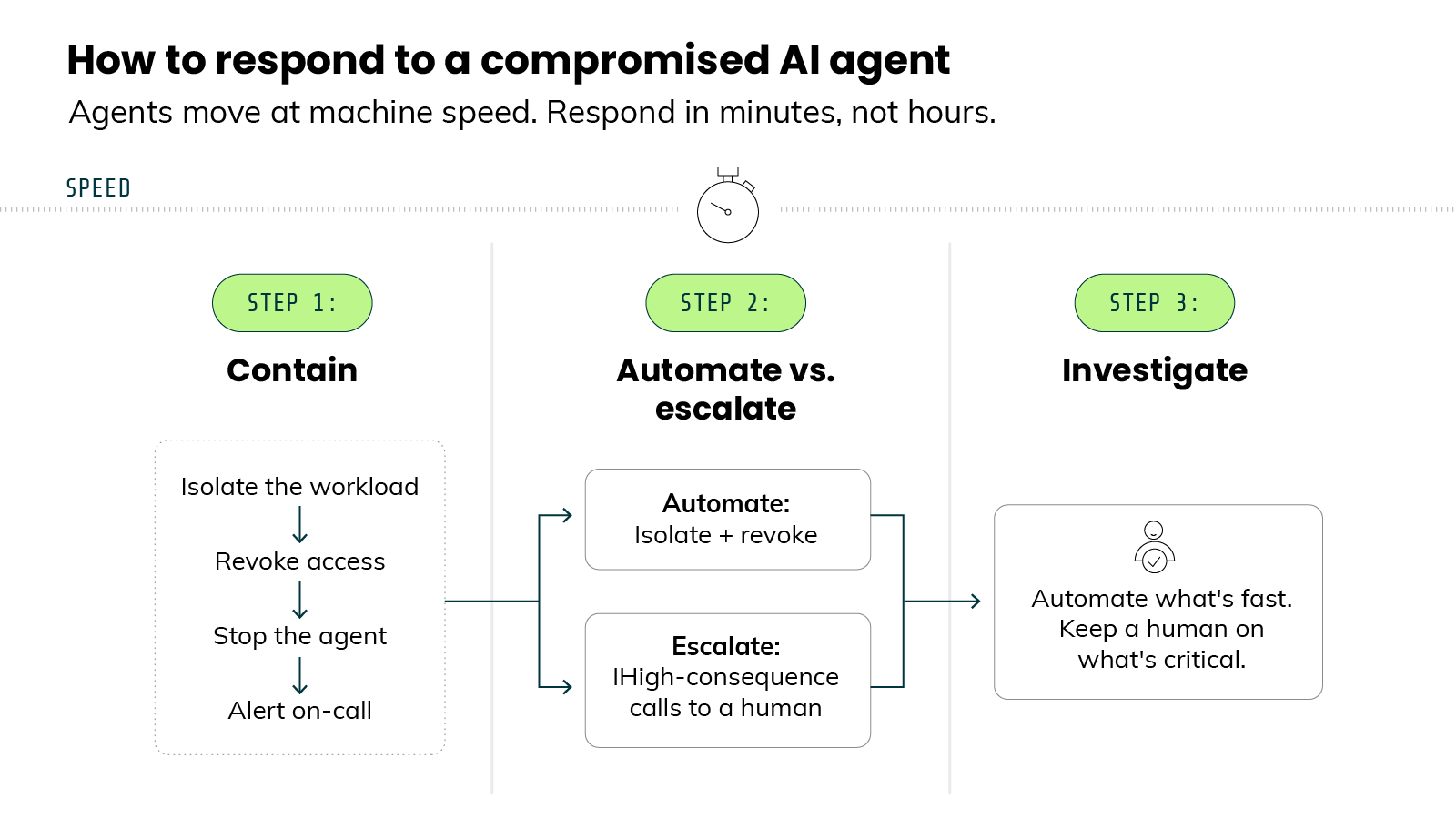
Why speed decides the outcome
Cloud attacks are fast. One documented attack moved from initial access to stolen data in three minutes and forty-two seconds, according to the Sysdig 5/5/5 Benchmark for Cloud Detection and Response. No manual incident process runs that quickly.
Agents raise the stakes further. They act at machine speed. A compromised agent keeps calling tools and taking actions until something stops it.
So manual response is often too slow. By the time a ticket is assigned, the damage may be done. The goal is to shrink the gap between detection and action as close to zero as you can.
How to contain a compromised AI agent
When a detection fires, a few actions matter most.
- Isolate the workload. Cut the agent's container off from the network so it can't reach anything else.
- Revoke its credentials. An agent acts on the access it holds. Take that access away and most of its options disappear.
- Stop the agent. End the process or session so it can't keep acting.
- Alert the right people. Route the event to the on-call responder with the context they need.
The first two are also the ones to automate. Containment and credential revocation don't need to wait for a human, and automating them recovers the minutes manual response loses.
Pro tip: Revoking an agent's credentials stops future use, not past theft. Whatever it already reached is likely compromised, so rotate that too.
When to keep a human in the loop
Not every action should run on its own. Some are too consequential to hand fully to a machine.
Regulation reflects this. The EU AI Act requires human oversight for high-risk AI systems, including the ability to watch what a system is doing and to step in or stop it.
So split the two. Automate low-risk containment. Escalate high-consequence decisions to a person, and make sure a responder can always intervene and shut an agent down.
This balance is starting to scale. A newer approach uses dedicated agents to oversee other agents, and in some designs to block an action before it completes. The reason is simple: most AI applications will rely on multiple agents within a few years, and when agents coordinate at machine speed, people can't review every step.
Once the agent is contained, the work shifts to investigation. But that's a discipline of its own.
Next, we'll bring prevention, detection, and response together into a single program.
Pro tip: Set the automate-versus-escalate line before an incident, not during one. And keep the human list short. Escalate too many routine actions and responders just start rubber-stamping them.
How to build an agentic AI security program

You don't secure agents with a single control. You build a program. And that comes down to three steps: map where your agents can be attacked, layer prevention, detection, and response across that surface, and put the tooling in place to run it at the speed agents operate.
Here's what each step involves.
Step 1 - Map your attack surface
You can't defend what you can't see. So begin with an inventory:
- Find where agents run.
- List the tools and MCP servers each one can reach.
- Note the credentials each one holds.
That inventory is the foundation. Every control you add later depends on it.
Then model the threats. A structured method helps. One framework built for this is CSA's MAESTRO. It maps threats layer by layer across the agent stack, from the model to the tools to the orchestration between agents.
Why bother? Because it ties each control to a real attack. Not a generic checklist. The specific ways your agents can be compromised, such as MCP tool poisoning, prompt injection, and credential theft covered earlier.
Step 2 - Layer prevention, detection, and response
With that picture in hand, you apply three layers. Each one covers what the others miss.
- Prevention. Give each agent its own identity. Scope its access to the current task. Prefer short-lived credentials over standing access. And sandbox the agent so its environment can do only what the task needs.
- Detection. Prevention leaks, so you watch what the agent does at runtime. Flag known bad actions. Treat the sandbox boundary as a hard limit. Audit tool calls for context.
- Response. When something fires, contain it fast. Isolate the AI workload. Revoke the credentials. Automate the first steps. And keep a person on the high-consequence decisions.
Notice how they reinforce each other. Prevention shrinks the attack surface. Detection catches what slips through. Response limits the damage. No single layer is enough. Together, they close the gaps.
Step 3 - Put the right tooling in place
The detection layer needs somewhere to run. Open source runtime security engines, like Falco, provide the foundation. They watch system level activity and flag known bad behavior with rules you can read and tune.
At scale, teams add a managed layer on top. That layer:
- Keeps detection rules current as attacks evolve.
- Ties alerts to standard technique identifiers.
- Inventories where agents and AI packages run.
- Routes response into the incident process the team already uses.
The point isn't the product. It's the coverage. Whatever you choose, the requirement is the same. See what agents do at runtime. And act on it quickly.
Remember: agentic AI security is a program, not a tool.
Prevention is the first line, and a necessary one. But agents fail while they run, using access and tools they're trusted to have. So a real program watches what agents actually do. Then it acts before the damage spreads.
Prevent. Detect. Respond. Align them with how agents are actually attacked. That's how you secure AI agents in 2026.
Agentic AI security FAQs
Sources
- Chen et al., "AgentPoison: Red-teaming LLM Agents via Poisoning Memory or Knowledge Bases," 2024
- Chen et al., "StruQ: Defending Against Prompt Injection with Structured Queries," 2025
- Zhang et al., "Agent Security Bench (ASB): Formalizing and Benchmarking Attacks and Defenses in LLM-based Agents," 2025
- Wu et al., "IsolateGPT: An Execution Isolation Architecture for LLM-Based Agentic Systems," 2025
- Liu et al., "TraceAegis: Securing LLM-Based Agents via Hierarchical and Behavioral Anomaly Detection," 2025
- He et al., "SentinelAgent: Graph-based Anomaly Detection in Multi-Agent Systems," 2025
Blog: JADEPUFFER: Agentic ransomware for automated database extortion